

Start the Year Strong: Establish Listening Expectations
As you settle into the rhythm of a new year, setting clear listening expectations is important. Teaching students listening skills is just as important as teaching academic skills.
Why Listening Matters at the Beginning of the Year
Your students may not always be consciously aware of what good listening looks like. By explicitly modeling expectations and behaviors, you’re building a classroom community rooted in respect, focus, and meaningful communication—skills essential for academic success and social development.
Three Key Strategies to Launch Your Listening Culture
1. Teach It Explicitly (Not Implicitly)
Create anchor charts to define listening behaviors—like making eye contact, staying quiet, raising hands, or waiting your turn. Teaching in this structured way leaves little room for ambiguity and helps students internalize what and how to listen.
2. Model, Practice, and Give Feedback
Demonstrate “full-body listening” or use a quick role-play. Invite students to practice, then provide gentle, specific feedback on what they did well and what to improve. Provide positive reinforcement and be consistent with your reteaching when necessary.
3. Make Listening an Active Process
Integrate techniques like “choral repeat” (students repeat instructions aloud), or nonverbal signals like thumbs-up or a listening posture to show they’re tuned in. You can also implement “three before me”—encouraging students to ask three peers first if they missed instructions.
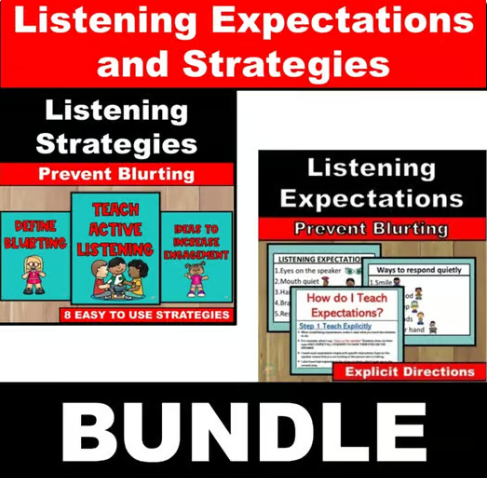
Grab my resource that has strategies and expectations. You can use these ideas to
- engage students in your classroom expectations
- prevent blurting
- teach your expectations
- reteach when necessary
- use the tools included -worksheets and anchor charts
Sample First-Week Plan
| Day | Focus |
|---|---|
| Day 1 | Introduce listening expectations using anchor charts. Model good vs. poor listener and discuss. |
| Day 2 | Conduct listening “scenarios”: students show correct behavior, then reflect in pairs. |
| Day 3–4 | Practice with academic content—read aloud or give directions, prompt students to signal understanding. |
| Day 5 | Use reteaching worksheets or centers to support students who need more reinforcement. |
Benefits You’ll See
- More on-task behavior: Students will follow directions accurately and quickly, reducing interruptions and improving instructional flow.
- Increased engagement: When students know what’s expected, they’re more confident in participating.
- Positive classroom culture: Respectful listening fosters community and mutual understanding—perfect for collaborative learning environments.
Need more ideas?
Read this blog post for more back to school ideas!
Final Tip: Reinforce and Reflect
Even after the first week, revisit listening expectations naturally. Print out visuals in your learning corner and celebrate “super listeners” to reinforce habits—without relying on extrinsic rewards. This sustainable, kind-yet-firm approach helps students see listening as a shared norm, not a contest.
By starting year one with intentional, clear expectations around listening—and leveraging tools like the explicit-instructions resource—you’ll create a respectful, attentive, and thriving classroom from day one.
Check out the preview for this bundle to improve your classroom management!
Supporting you always!